How Horticultural Therapy is helping people through life’s challenging moments and why your own garden might be exactly the right place to start.
We talk a lot about getting outside for our wellbeing. But what if your garden could do more than lift your mood for half an hour? What if it could help you process grief, rebuild confidence after illness, or find a sense of calm when life feels out of your control? That is exactly what Horticultural Therapy offers.
Sam Mallet, GreenArt’s Thrive-qualified horticultural therapist explains how it works: one garden and one client at a time.
From a Difficult Patch to a Calling
As a child, Sam was given her own tiny strip of soil beneath a conifer hedge “a place where not even weeds would grow.” Undeterred, she carried soil from other beds, bought the brightest flowers she could find at Woolworths, and quietly transformed it. Looking back, she sees that patch as the start of everything.
“Even in the most challenging conditions, things can grow with the right care and attention. I came to see people the same way, for whatever reason they feel unable to blossom, they can thrive with care and understanding.“
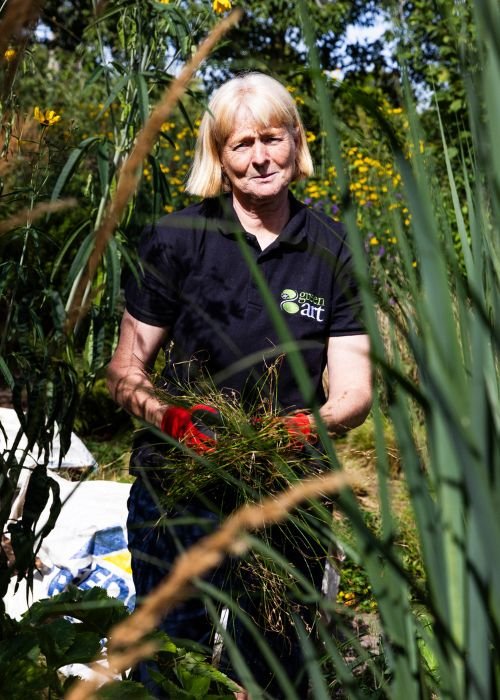
That conviction has shaped her 25 years in horticulture; from Plant Manager at a leading Garden Centre chain to NHS garden projects at the John Radcliffe Hospital. Alongside her work, Sam has experienced her own personal journey through therapy, during which she realised that the grounding she found in the garden, could itself be therapeutic. She qualified in Social and Therapeutic Horticulture with Thrive in 2018.
More Than a Feeling – The Science
Sam’s year-long qualification, accredited by Coventry University, went well beyond the practical. It gave her the scientific evidence behind what she had always sensed intuitively. It included research suggesting that bacteria naturally present in soil may support the brain’s production of serotonin, the same mechanism targeted by certain antidepressants. Getting your hands in the ground, it turns out, may be doing something genuinely measurable.
“I knew unconsciously how gardening had helped me. The training gave me the science behind it and the professionalism to bring it to others.”
So What Is Horticultural Therapy?
Horticultural Therapy is a holistic, person-centred approach that uses plants and gardens to improve physical and mental wellbeing. It is recognised by the NHS and recommended by Nice (National Institute for Health and Care Excellence). A trained practitioner builds a programme of activities around each individual’s specific needs and goals, using the garden as both the setting and the medium for change. Sam brings a skilled, non-judgemental approach and holds a space of trust, with the primary focus always on connecting back to nature, to the season, to something living and growing.
Sessions work well alongside other support networks such as CBT or counselling, but they can equally stand alone, particularly for people who might not consider themselves “therapy people” but who love their garden and sense it could offer more.
Each GreenArt Horticultural Therapy session lasts around 90 minutes, one-to-one, in the client’s own outdoor space.
“We might talk, we might plant something, or we might just sit and notice what’s already there. The garden becomes a mirror, reminding us that change is natural, that growth isn’t always linear, and that new beginnings are always possible.”
The Difference It Makes
Much of Sam’s Horticultural Therapy work supports people through periods of difficulty or transition.
Navigating Serious Illness
One client was midway through cancer treatment when she first reached out to Sam. She wanted to support her own recovery but felt like she had lost control and as though everything was happening to her. Sam suggested they try growing food together.
What followed was a gradual but real transformation. Rather than spending her time scrolling through her diagnosis online, she began researching the nutritional benefits of what she was growing; cucumelons, goji berries and other, unusual varieties chosen with curiosity and intention. Sessions became something to look forward to. By the time Sam left each visit, her client had tasks to get on with. She had, questions to explore, experiments with different ways of growing, and new things to try. The momentum continued between sessions.
“When you’re in treatment, so much feels out of your control. Growing something brings a small but powerful shift, from being looked after, to looking after something else. It balances the need to be nurtured with the need to nurture.”
Processing Grief
Another client reached out after losing her husband. On the surface it was a practical request for help with garden maintenance. But Sam quickly understood the weight behind it. The garden had been his domain, his pride and joy. And now, every time she looked out of the window, she watched it declining in his absence. The guilt of that was its own quiet grief, layered on top of everything else.
Rather than changing the garden, they worked with it. They created memory beds; buddleias he had loved, plants that carried specific moments with them and small spaces to sit and reflect. Slowly, over the course of their sessions, the garden shifted. From somewhere she could barely bring herself to face, it became somewhere she could go to be with her loss. Not to escape it, but to sit with the feelings. To understand the circle of life and to begin to make peace with that.
“It became a place where she could process her grief and, in time, learn to own the garden as hers. In a way that felt right for her now.”
Rebuilding Independence
Over eighteen months, meeting once a month, Sam worked with a client who had lost a limb following illness and who could no longer access her garden in the way she once had. What had been a deep source of joy had become a daily reminder of what she’d lost. She had begun to feel that the garden, like so much else, had been taken from her.
Together they remade the space around her: raised beds at wheelchair height, paths widened for easier access, pots simplified, planting chosen to work with her energy levels rather than against them. And they introduced cut flowers, something she could grow with her own hands and give away to friends and family.
Gradually, the birds and bees returned to the garden she had feared she’d neglected. And with them came something she hadn’t expected to feel again quite so fully: the sense that this place was still hers.
“That act of giving was really important,” Sam says. “It helped rebuild a sense of purpose and self-worth.”
You Don’t Need a Perfect Garden
The most common hesitation Sam hears is that people feel their space isn’t good enough. She is consistent on this point: it is not the condition of the garden that matters, it’s the relationship with it.
“Some of the most powerful work happens in the most ordinary gardens. Even noticing one plant, or spending a few quiet minutes outside, can make a difference.”
And for those who find group wellbeing activities overwhelming, one-to-one sessions offer something gentler, at your own pace, in a space that is already yours.
After losing both her parents last year, Sam found herself returning to her own garden, planting spaces of remembrance, drawing on exactly the same principles she brings to her clients.
“Nature teaches you resilience. You need the rain as much as the sun. And if your roots are in the right place, you can keep growing.”
If there’s one thing she hopes people take away, it’s simple: “It’s not about how much you do. It’s about creating a space where you can pause, notice, and feel supported.”
And sometimes, that space is right outside your back door.
Not sure where to start?
Discover what Garden Creature you are, a fun way to explore how nature might support your wellbeing.
Book a free discovery call with Sam.